In this tutorial, we will understand the difference between a single-page application (client-side rendered or CSR) and a multi-page application (server-side rendered or SSR).
Even though the capabilities of JavaScript have increased and it can now be used to create mobile apps and desktop apps, but its prominent usage is still more for the web applications.
Web applications have become more performant and they can be rendered as it is inside the mobile view and desktop app given the feeling of using native applications while still they can be coded as web applications.
All this has been possible because of the advancement in the rendering patterns of web applications.
While there are many, we are going to discuss two specifics ones, which are the most popular, Single page application (CSR) and Multi-page application (SSR).
Understanding both is extremely crucial as none of it is better than the other, it is all about the use case you are dealing with, and knowing both will help you to create a performance-efficient web application.
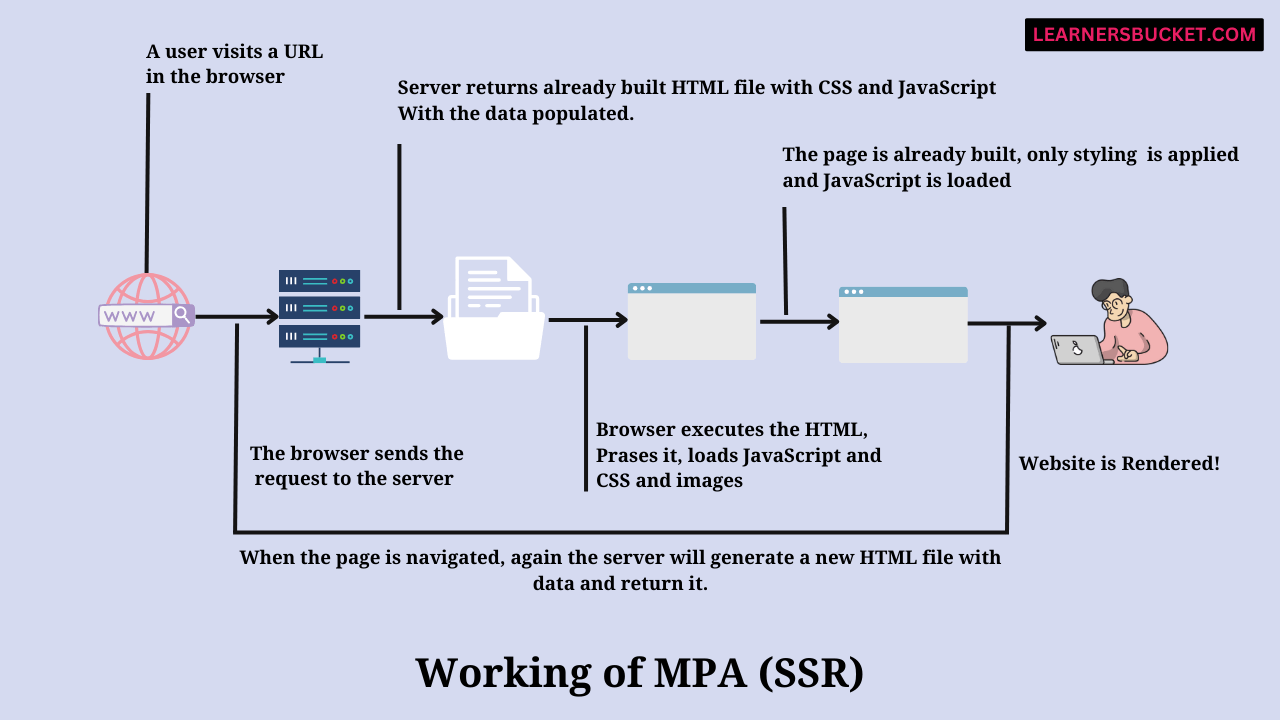
The term Multi-page refers that every time you navigate on the web application, a new HTML page is generated on the server and is returned to the browser, where the browser parses the HTML and displays the content.
These are the traditional rendering patterns that have been followed since the inception of web applications.
When a request to the server is made, the server generates the HTML page with all the content pre-filled and it returns it to the browser, where the browser applies all the styles or CSS, loads the assets, and shows the page.
While introduction of Ajax has reduced the number of round-trips to the server as the data can be fetched asynchronously and the UI can be updated on the run-time. But it can be only used for minor operations.