Being a web/frontend developer It is vital to understand how a web page is rendered in the browser because it really helps optimize the application performance.
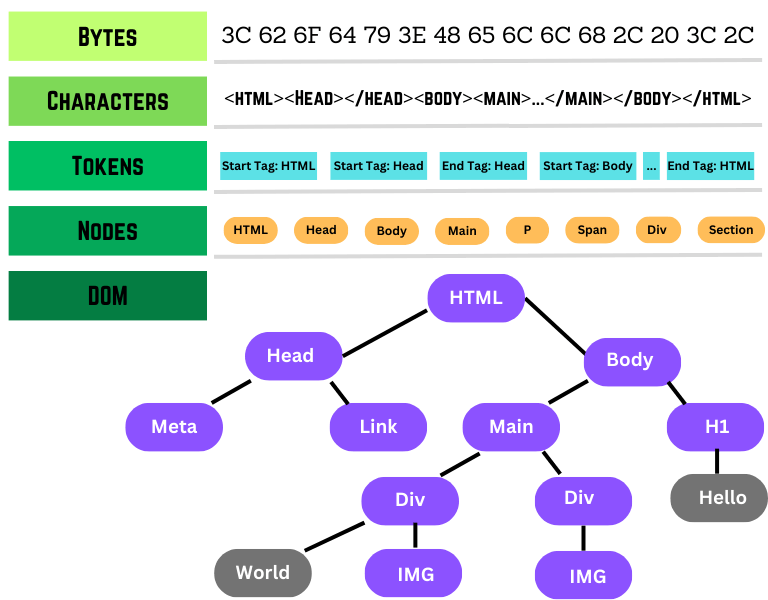
In each HTTP request that browser makes for an HTML page, the server returns the data into bytes, these bytes are then converted to Characters, Tokens, Nodes, and finally DOM (Document Object Model).
Once the DOM is generated, the parsing of the page starts, the HTML contains CSS code or links, JavaScript code or links, media elements such as images, etc, each of them is then parsed separately and plugged together to create a render tree, which is then converted to the layout and then is painted on the screen at the refresh rate of 60 frames per second.
This complete process is called a critical rendering path. Optimizing the critical rendering path helps to load the web page faster and without glitches or janks.
The complete page rendering can be broken down into 5 different steps.
When an HTML is returned as an HTTP response in the browser the data we receive is in bytes, which is then converted to characters, tokens, nodes, and DOM in the order.
The DOM (document object model) is created as the HTML is parsed as a tree-like representation of different HTML nodes. When the HTML is being parsed it encounters styles associated with DOM written inline or imported, script which when loaded can result in the DOM manipulation.
The external elements like scripts and media can be blocked, thus it may halt the HTML parsing until they are completely loaded. That is why it is always advised to load the script at the end or use defer / async so that web page is loaded smoothly.
Once the Styles are loaded the CSSOM (CSS object model) is formed which is then matched with their respective HTML element node in the DOM via the browser engine.
CSS object model is similar to the DOM in structure but differs in nature. As the DOM stores all the content of the web page, CSSOM stores all the styling information. It blocks the rendering of the webpage until all the CSS style is loaded, parsed, and applied to each DOM node. It is blocking in nature because CSS styles can be overridden.
Each browser engine follows a set of rules for CSS to apply the styles to the corresponding DOM node. The C in the CSS stands for cascade, thus the styles are also cascaded down, which means the child nodes inherit few styles from the parent nodes.